Counting aloud and recognizing numbers are two different skills, and parents often discover that gap the hard way. A child who can chant "one, two, three, four, five" flawlessly may still stare blankly when asked to point to the numeral 4.
Number recognition — connecting the spoken word to the written symbol — is the bridge between counting and real math. Here are ten activities that build it, plus the order to introduce numbers so the skill actually sticks.
Teach Numbers in the Order That Works
Before the activities, one critical decision: what order to introduce numerals. Resist the urge to go 1, 2, 3, 4, 5 in sequence. Digits have very different shapes, and a shape-based order makes recognition far easier.
- Start with 1, 2, 3 — simple shapes your child already counts daily.
- Add 0 and 10 — easy shapes, big concept payoff.
- Then 4, 5, 6 — straight lines and curves, slightly trickier.
- Save 7, 8, 9 for last — the hardest shapes to distinguish.
Flash Card Games (Fast and Effective)
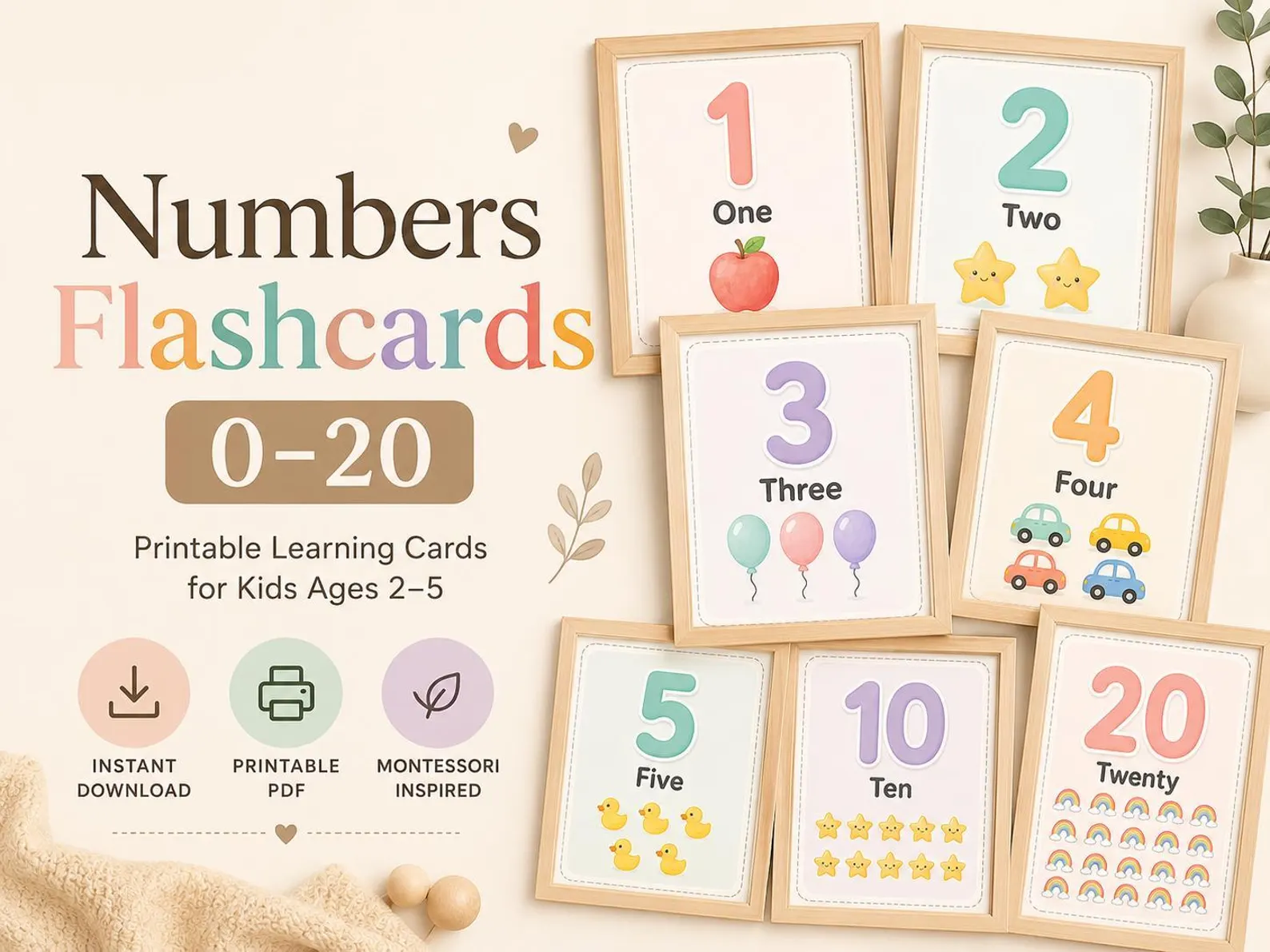
Flash cards get a bad rap, but used as a game they are among the fastest ways to build recognition. The Numbers 1-20 Flash Cards Printable | Preschool Learning | Home Counting Activity | Toddler Math Flashcards | Kindergarten Printable | PDF set — large, easy-to-read numbers with matching counting objects — is built for exactly this.
- Flash and name — flip a card, name the number, flip back. Ten seconds, done.
- Find the number — lay out five cards, call out a number, child points to it.
- Missing number — lay out a sequence, remove one, child says which is missing.
- Number line scramble — put a 1-10 set in order, then a 1-20 set.
- War — each player flips a card, higher number wins the pair.
Movement and Number Games
Numbers learned with the body are numbers remembered. These active games turn recognition into a full-body experience.
- Number hop — hop to the numeral card when it is called.
- Clap and count — show a card, child claps that many times.
- Number freeze — dance, freeze on a number, name it.
- Number hunt around the house — find the numeral on clocks, remotes, and books.
- Staircase counting — point to each step as you climb, then trace the numerals with your hand.
Everyday Number Recognition
The best number recognition practice hides in ordinary life. Point out numbers on the cereal box, the elevator, the speed sign, the TV remote. Ask your child to find "the number 3" on the grocery receipt, or to match house numbers as you walk. Brief, frequent, real-world exposures are worth more than a long worksheet session.
Counting Objects Alongside Recognition
Recognition and counting must grow together, or a child ends up knowing the name of a symbol without knowing what it means. After your child names a card, always follow with the quantity question: "How many is five? Count these buttons." Connecting the numeral to objects seals the meaning.
Use one-to-one correspondence — one touch, one count — and keep the counts small and honest. Five buttons counted slowly and carefully beat twenty counted carelessly.
The 1-20 Milestone
Reaching twenty is a major preschool milestone, but it usually takes months of patient play. Do not expect 11-20 to come quickly — the teen numbers are a notoriously confusing stretch because their names are inconsistent (why "thir-teen" and not "three-teen"?).
- Master 1-10 thoroughly before introducing 11-20.
- Teach teens in pairs: 11 and 12 first (the exceptions), then 13-19 in groups.
- Use a number line so children see 10, 11, 12, 13 flowing in order.
- Count backwards from 20 to 10 — it strengthens the teen sequence.
When to Move On
When your child can instantly name the numbers 1-20 and count that many objects, recognition is firmly established. Celebrate with a bigger challenge: writing numbers freehand, comparing quantities ("which is more?"), or simple adding and taking away. All of it rests on the recognition you built together.
For the printable side of recognition practice, the Numbers 1-20 Flash Cards Printable | Preschool Learning | Home Counting Activity | Toddler Math Flashcards | Kindergarten Printable | PDF cards give you twenty large, soft-pastel number cards with counting objects — and the Flash Cards hub has more ideas for making rapid review a daily habit.
Frequently Asked Questions
At what age do children learn to recognize numbers?
Most children recognize a few numerals by age three and master 1-10 recognition between four and five, with 11-20 following by kindergarten. As always, readiness varies — follow your child's interest and keep it playful.
Should I use flash cards to teach numbers?
Yes, as a fast, fun game — not a drill. A few minutes of "flash and name," "find the number," or "missing number" a few times a week builds recognition speed efficiently. Pair cards with counting objects so numbers keep their meaning.
Why does my child know how to count but not recognize numbers?
Counting is a verbal skill (a memorized sequence), while recognition is a visual skill (matching a symbol to a name and quantity). They develop independently, so a gap is normal. Daily recognition games, with quantities attached, close it quickly.
What is the hardest part of teaching 11-20?
The teen numbers are confusing because their names are irregular. Master 1-10 first, teach 11 and 12 as exceptions, then learn 13-19 in groups, and use a number line so children see the sequence visually.
How many numbers should I introduce at a time?
One to three new numbers per week is a good pace. Return to the full set often so older numbers stay fresh while new ones are added. Recognition is built by revisiting, not by moving on forever.
The Bottom Line
Number recognition is the quiet bridge between counting songs and real mathematics, and it is built in small, playful, daily moments. Teach in a shape-friendly order, pair every numeral with a quantity, and let movement and games carry the repetition.
Start with the Numbers 1-20 Flash Cards Printable | Preschool Learning | Home Counting Activity | Toddler Math Flashcards | Kindergarten Printable | PDF flash card set — large, easy-to-read numbers, counting objects, and soft pastel colors — and turn five minutes a day into a child who truly knows their numbers.
Related Reads
Keep exploring with these helpful guides: