Matching looks like the simplest activity on earth — put the dog picture with the dog picture, connect the sock to its pair. But under that humble surface, matching is doing something remarkable: it is training the exact cognitive skills that reading, math, and attention all depend on.
This article unpacks what matching actually teaches, why it belongs in every preschool routine, and how printable matching worksheets turn a five-minute game into a structured learning session.
What Matching Really Trains
When a child matches, they are not just sorting pictures. They are running a precise mental process: look at an object, hold its features in mind, scan the options, compare, and confirm. That sequence is a workout for several distinct skills.
- Visual discrimination — spotting the differences between similar items, the foundation of reading.
- Working memory — holding one item "in your head" while you search for its match.
- Attention and scanning — systematically looking rather than guessing.
- Categorization — the early logic of grouping by features.
- Fine motor control — pointing, drawing lines, and placing cards precisely.
Matching Is Training Wheels for Reading
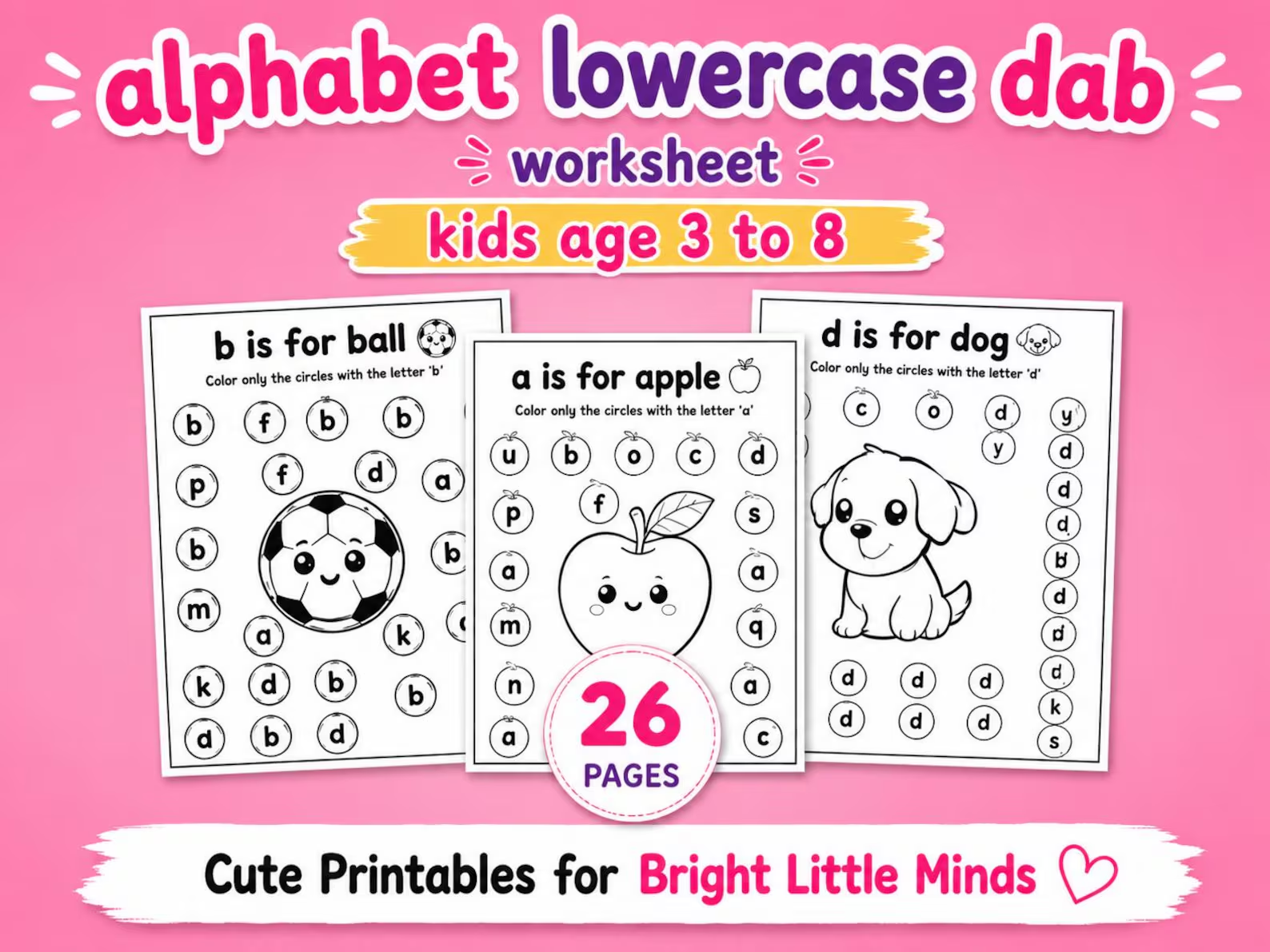
Reading requires a child to tell apart letters that look nearly identical: b and d, m and n, p and q. Matching activities build exactly that visual discrimination, starting with obvious pairs and gradually working toward subtler differences.
This is why early-childhood programs so often use picture matching before letters. A child who can reliably match two similar pictures has practiced the same visual skill they will later use to tell a "b" from a "d."
Matching Is Training Wheels for Math
Matching also feeds math. Sorting and matching by shape, size, or number teaches classification, comparison, and one-to-one correspondence — the very concepts behind counting and arithmetic. Matching numerals to quantities (a 5 card matched to five dots) is a direct bridge from recognizing digits to understanding what they mean.
The Three Levels of Matching (Start Here, Go Slow)
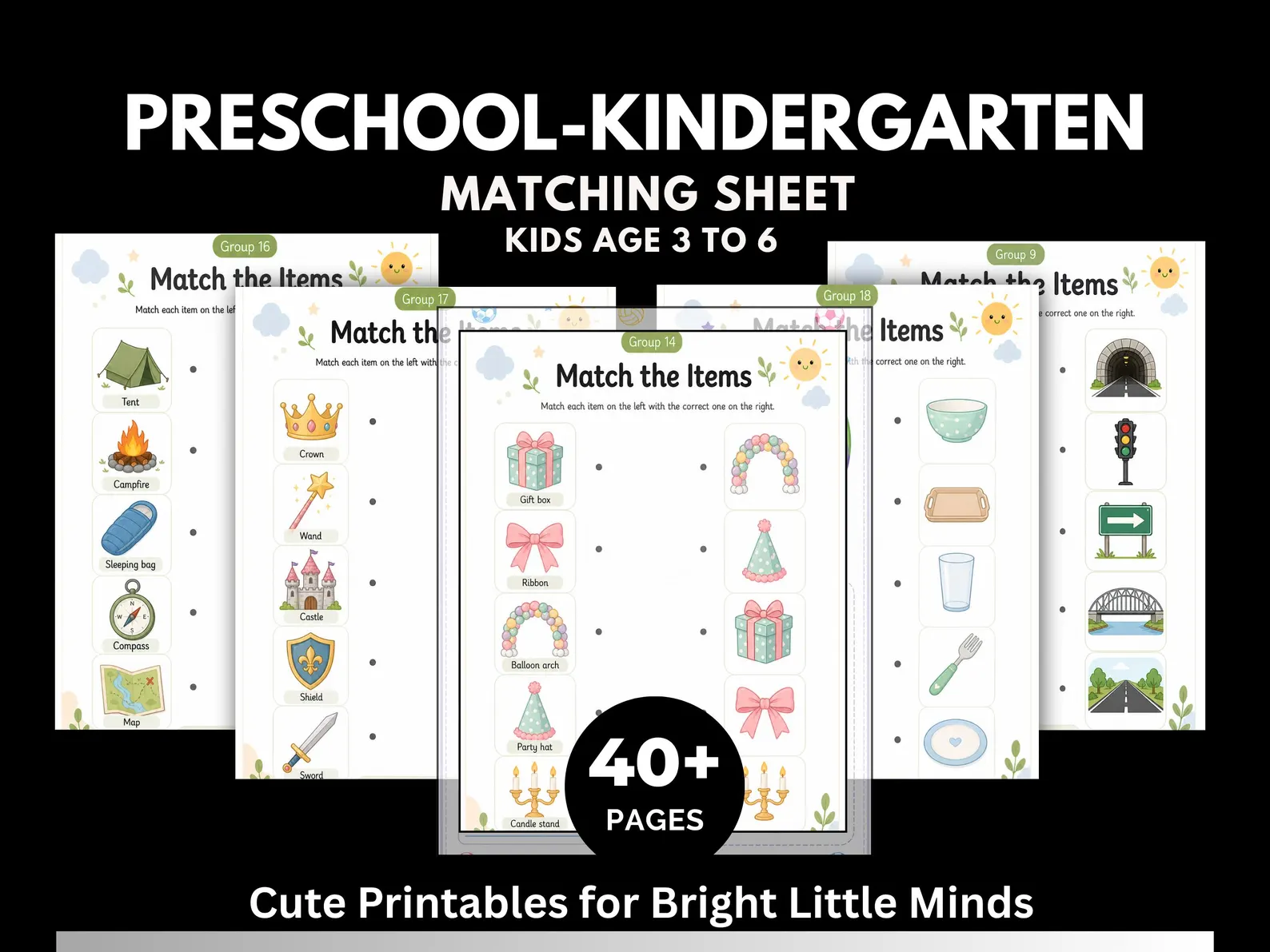
Printable matching worksheets cover levels two through four beautifully — the Printable Matching Worksheets, Kindergarten Learning Activity, Match the Picture, Educational Pages, Homeschool , Busy book, 40+ PDF set includes forty-plus pages of picture, category, and concept matching for exactly this progression.
| Level | What it looks like | Typical age |
|---|---|---|
| Identical matching | Match two identical pictures | 18-30 months |
| Similar matching | Match items that look alike but not identical | 2.5-4 years |
| Concept matching | Match by category, feature, or quantity | 3-5 years |
| Memory matching | Match pairs hidden face-down | 3-6 years |
How to Use Matching Worksheets Effectively
A matching worksheet works best when the child drives. Name the items on the page first, then let them find the matches in their own order. For drawing-line matching pages, have the child point to both matches before they draw the line — the pointing does the thinking, the line just records it.
Keep sessions short, celebrate the process ("you looked carefully!"), and reuse laminated pages so favorite sheets can be played again. Matching, like all early learning, is built on repetition that stays fun.
Matching Games Beyond Worksheets
Pair your printable pages with real-world matching to make the skill concrete.
- Sock pairs — the original matching game, in your laundry.
- Memory card game — the classic, scaled to your child's level.
- Shape and object sorting — buttons, blocks, and toys into groups.
- Matching shoes — pair up the family's shoes in the hallway.
- Picture-to-object — match a photo card to the real object.
- Color matching — sort toys into colored baskets.
Signs the Skill Is Really Growing
You will know matching is working when your child starts self-correcting — pointing at a wrong match, pausing, and trying again. That pause is executive function in action. Watch also for faster scanning, more accurate pairs, and transfer to new materials (matching letters when you only ever practiced pictures).
For more ways to build these foundations, browse the Early Learning hub and the Preschool Learning collection.
Frequently Asked Questions
Why are matching activities important for toddlers?
Matching is one of the earliest ways children practice visual discrimination, working memory, and categorization — the cognitive foundations of reading and math. It is also perfectly matched to toddler abilities, making it a confidence-building first "thinking" activity.
What is the difference between matching and sorting?
Matching is pairing one item with its equivalent ("this dog with that dog"). Sorting is grouping many items by a shared feature ("all animals here, all vehicles there"). Sorting is a slightly harder skill that matching naturally leads into.
When should my child be able to do a memory card game?
Most children can play a simplified memory game (four to six pairs) around age three, and full classic memory by four or five. Start with identical pairs and few cards, then increase the number and similarity as your child improves.
How are matching and reading related?
Reading requires distinguishing visually similar letters like b/d and p/q. Matching games build exactly this visual discrimination, beginning with obvious differences and progressing to subtle ones, which transfers directly to letter recognition.
How often should children practice matching?
A few short sessions a week is plenty. Matching is a skill that builds through consistent, enjoyable repetition. Five minutes of matching play, three or four times a week, produces steady progress without burnout.
The Bottom Line
Matching may be the most underestimated activity in early learning. It quietly trains the visual discrimination, memory, and focus that literacy and numeracy depend on — all inside a game a child actually wants to play.
The Printable Matching Worksheets, Kindergarten Learning Activity, Match the Picture, Educational Pages, Homeschool , Busy book, 40+ PDF pack gives you forty-plus ready-made matching pages, from identical pairs to concept matching, so you can move up the ladder without reinventing it each week.
Related Reads
Keep exploring with these helpful guides: